Mathematics in Ancient India
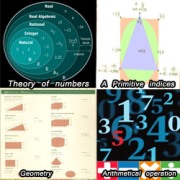
Mathematics In Ancient IndiaAncient India had a great tradition for mathematics. The origin of the ancient mathematics can be traced to the Indus valley civilization. There are some artifacts that clearly give the evidence of mathematical knowledge of the Indus valley people.
A number of scales for measuring the length were discovered during the excavations from the Indus sites. A decimal scale known as 'Indus Inch' based on a unit of measurement of 1.32 inches (3.35 cm) has been discovered. Another scale, a bronze rod was discovered that marked 0.367 inches.
It is postulated that these measurement were used in the buildings and other urban structures by the Indus people with great accuracy.
It is being suggested that the Indus people adopted a uniform system of weights and measures. This belonged to two series both being decimal in nature multiplied and divided in two giving ratios of 0.05, 0.1, 0.2, and 0.5 etc.
However, not much is known about the full extent of the mathematical achievements of the Indus valley civilization.
Development of Mathematics in Vedic period
The development of mathematics and astronomy made great strides during the Vedic age. This was because the religious belief system wanted it to be applied for religious purposes.
The earliest recorded book Vedas had Sulbasutras that has appendices giving rules for constructing altars for performing rituals. The Sulbasutra also give geometrical information to be used for the same purposes. Sulbasutras were composed by scholars and priest over a period of time. They are Baudhayana (about 800 BC), Manava (about750 BC), Apastamba (about 600 BC) and Katyayana (about 200 BC).
.jpg "Baudhayana - Indian Mathematician")
Baudhayana Budhayana was the first Indian mathematician to calculate the value of 'pi' in the 6th century AD. He explained the concept of Pythagorean Theorem.
The system of education in Vedic period restricted mathematical studies to priests and sages and lacked systematic approach as it was meant to be applied for religious purposes.
Their system of education was based on the traditions and it was handed over to the generations. Mathematics remained an applied science and it focused on developing methods to solve practical problems.
Jaina Mathematics
The development of new religions like Buddhism and Jainism around 6th century BC saw more development in the field of mathematics. The main topics were theory of numbers, arithmetical operations, geometry, and operations with fractions, simple equations, cubic equations, quadratic equations and other permutations and combinations.
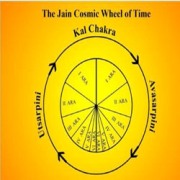
Jaina mathematicsJaina mathematicians developed a theory of infinite containing different levels of infinity, a primitive understanding of indices and some notion of logarithms to base 2.
The use of numbers came into vogue around the middle of the third century BC when the Brahmi numerals began to appear. The earliest epigraphic evidence of the use of numerical system is found in the inscriptions of Ashoka in the third century B.C.
A Mathematician named Pingala (c. 100BC) developed a system of binary enumeration convertible to decimal numerals. He described the system in his book called Chandahshaastra. The system he described is quite similar to that of Leibnitz.
Ancient Mathematics role in development of Astronomy
Mathematics played a major role in the development of astronomy. This is because accurate calendars were required to observe the religious ceremonies at the correct time. This required correct information about the planets and other heavenly bodies. And for this mathematics was used as a tool for making astronomical calculations. Astronomy was studied as a Vedanta and was called Jyotisa. The most famous work on Hindu astronomy is Suryasiddanta.
In second century AD Yavanesvara translated Greek astrology text (120 BC) popularizing it by adding Indian cultural icons and Hindu religious images. It’s around 500 AD the classical era of Indian mathematics and astronomy begins.
Aryabhata, the great mathematician and astronomer writes the book Aryabhatiya, which contains summery of Jaina mathematics and astronomy. He replaced the older theory of demons Rahu and Ketu with new theory of eclipses.
He also introduced trigonometry to make his astronomical calculations based on the Greek epicycle theory. He solved undefined equations with integer solutions.
Under Aryabhata, Kusumapura emerged as leading centre of astronomy and mathematics in ancient India. The other prominent centre was Ujjain where Varahamihira made valuable contributions to astronomy and trigonometry. He wrote Brihat Samhita a well-known work on astronomy. A contemporary of Varahamihira, Yativrsabha based his work on the main ideas of Jaina mathematics.
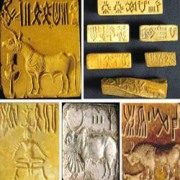
Indus InchThe next important figure of Ujjain school was Brahmagupta in 7th century AD. His work Brahmasphuta-Siddhantas or rules for numbers made significant contributions to the development of negative number system and zero. He also made contributions to the understanding of integer solutions to undefined equations and worked on interpolation formulas invented to aid the computation of sine tables.
A contemporary of Brahmagupta, Bhaskara I led Asmaka school. He was a commentator on the works of Aryabhatta. Lalla was another astronomer, born 100 years after Bhaskara I, who also wrote a commentary on Aryabhatta.
The 9th century AD saw several mathematical scholars like Govindaswami, Mahavira, Prthudakasvami, Sankara and Sridhara. While last three wrote commentaries on the works of Bhasker I, Mahavira became famous for updating Brahmagupta's book.
This period saw tremendous improvements in sine tables, solving equations, algebraic notation, quadratics, indeterminate equations and improvements to the number system.
The period from 500 AD to 1000 AD no doubt saw some great development in mathematical and astronomical science, but in terms of scholarly contributions, it was only commentaries written on the earlier works of mathematicians.
There was no fresh revelations and scientific research during this period. This is attributed to the rigidness in the religious belief system that restricted further growth of knowledge.
Contribute More Facts