Important People of Ancient India
Ancient Peoples of India
In present India, the ancient people are those that continued without much mixing with outsiders. They are the tribes of India which remained almost genetically untouched. Some of the ancient tribes of India are Bagri, Banjara, Ahir, Asur, Bodo, Hmar, Bhutia, Andamanese tribes, Khasi, Bhil, Gaddi, Dhodia, Angami, Chakmas, Oran, Chenchu, Santhal, Jarawa, Gujjar, Khond, Munda, Naga, Gonda, Lalung, Chamar and the Toda tribes.However in the ancient scriptures there is mention of various type of people or beings. In the Mahabharata and the Ramayana, and the Puranas, there is mention of beings that were superhuman or subhuman and even extraterrestrials. These groups include the Gandharvas, Yakshas, Kinnaras, Kimpurushas, Rakshasas, Nagas, Suparnas, Vanaras, Vidyadharas, Valakilyas, Pisachas, Devas (within them Vasus, Rudras, Maruts, Adityas) and Asuras (within them Danavas, Daityas, Kalakeyas and Nivatakavachas.)
Famous People of Ancient India
There are many great people who lived in ancient India. They were the kings, the saints and sages, mathematicians and people with the knowledge of art and literature.
It’s very difficult to put all of them from 1000 BC to 1000 AD. The names of a few prominent personalities that decorated this time line is mentioned here to a bird’s eye view.
Important Kings in Ancient India
Chandragupta Maurya
(324–184 BC) - Chandragupta Maurya laid the foundations of a powerful Mauryan empire that for the first time gave political unity to India.
Ashoka (273–232 BC)
- Asoka was a famous king of the Mauryan dynasty who ruled a large part of India. He turned to Buddhism after the historic Kalinga war. Ashoka got his edicts inscribed on monolithic stone pillars adorned with strikingly beautiful animal capitals.
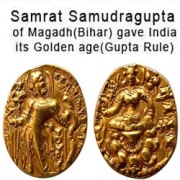
Samudra Gupta
(335–370 AD) - Samudra Gupta extended the boundaries of his empire from Nepal in the North to Tamilnadu in the South, from Assam in the East to present day Afghanistan in the West. The pillar inscription at Allahabad provides a detailed account of his conquests. His coins portray him as a patron of arts and one of his images is that of a Lute player.
Harsha Vardhana (606–647)
Harsha Vardhana unified Northern India and ruled it for over 40 years. He was the last emperor before the Muslim conquests to rule a unified Northern India.
Dharmapala
(781–821) Dharmapala was the Son of Gopala, who conquered Northern India from Burma to Afghanistan and Kashmir to the Narmada River.
Rajaraja Chola I
(985–1014)- Rajaraja Chola I considered the greatest of all Cholas, expanded the Chola Empire overseas to Sri Lanka
Rajendra Chola I
(1012–1044) - Rajendra Chola I expanded the Chola Empire overseas to South-East Asia.
Most Famous Mathematicians of Ancient India
Budhayana
was the first Indian mathematician to calculate the value of 'pi' in the 6th century AD. He explained the concept of Pythagorean Theorem. Yavanesvara translated Greek astrology text (120 BC) popularizing it by adding Indian cultural icons and Hindu religious images.
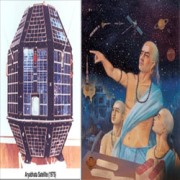
Aryabhata
Aryabhata
- Aryabhata was born in 476 AD. He was the first astronomer of India. His book, the Aryabhatiya, gives astronomical and mathematical theories. He has gifted 0 "zero" to the world.
Varahamihira in Ancient India
Varahamihira wrote Brihat Samhita a well-known work on astronomy. He also made valuable contributions to trigonometry.
Brahmagupta
Brahmagupta made significant contributions to the development of negative number system and zero. His work Brahmasphuta-Siddhantas or rules for numbers
Bhaskara I
Bhaskara I wrote commentary on the works of Aryabhatta.
Lalla
Lalla was another astronomer who also wrote a commentary on Aryabhatta.
Mahavira
Mahavira wrote commentary on Brahmagupta's work.
Famous Medicine Men in Ancient India
Charaka
Charaka, is considered being the father of medicine who consolidated it in his book charakasmitha.
Sushruta
Sushruta is called the father of surgery and he compiled his findings in the book Sushrutasamitha.
Patanjali
Patanjali a revered sage in ancient India developed the art of Yoga, a form of physical exercise to control diseases.
Authors in Ancient India
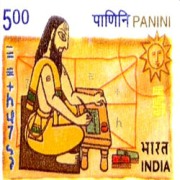
Panini
Panini
- Panini was a Sanskrit grammarian who gave a comprehensive and scientific theory of phonetics, phonology, and morphology. Panini's major work is a treatise called Astadhyayi.
Vishakhadatta
Vishakhadatta's Mudrarakshasa gives a glimpse of Maurya society and culture.
Kalidasa
Kalidasa in Malvikagnimitram mentions events of the Pushyamitra Sunga's reign.
Banabhatta
Banabhatta wrote Harshacharita that deals with the character and achievements of Harshvardhana.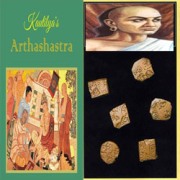
Arthashastra
Bakpatiraja
Bakpatiraja book Gaudabaho describes how King Yasovarman (725–752) of Kannauj killed the king of Magadha and conquered Gauda.
Bilhana
Poet Bilhana wrote Vikramanka Charita that describes the history of the reign of Chalukya king Vikramaditya VI. Kalhana- Kalhana's work Rajatarangini is a valuable book on the history of the kings of Kashmir.Kautilya or Chanakya
Kautilya or Chanakya, was a minister of Chandragupta Maurya. He was a Brahmin and his actual name was Vishnugupta. He wrote Arthashastra the famous work on statecraft.
Famous Travelers in Ancient India
Meghasthenes
Meghasthenes was a Greek traveler who visited India during the time of Chandragupta Maurya. He wrote his travelogue called Indica that provides valuable account of the governance and social life during the Maurya period.
Fa-Hien
(A.D. 399-414) Fa-Hien a Chinese scholar travelled to India in search of great Buddhist books of discipline. He visited India during the reign of Chandragupta II
Huen Tsang,
(603-664 A.D.) Hiuen-Tsiang was another Chinese scholars who visited India in search of knowledge. He visited India during the reign of Harshavardhana
Saints in Ancient India
Valmiki
Valmiki, was the great sage-poet who wrote Ramayana.
Veda Vyasa
Veda Vyasa is the author of the Mahābhārata
Mahavira
Mahavira, also known as Vardhamana, was the twenty-fourth and the last tirthankara of Jainism religion.
Gautama Buddha
Gautama Buddha, also known as Siddhārtha Gautama was a saint on whose teachings Buddhism was founded.Contribute More Facts