Ancient India Religion
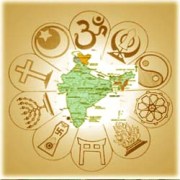
Ancient India ReligionReligion in ancient India evolved for the purpose of the promotion of righteousness and justice and for the growth of spiritual and moral solace. There are four distinct phase of religion in ancient India.
The first was being in its abstract shades during the Indus valley civilization. The second was in its distinct manifestation in the early and later Vedic periods. The evolution of Jainism and Buddhism as an offshoot of Hinduism marks the third phase. Buddhism and Hinduism coalesced after that till the reassertion of Hinduism and elimination of Buddhism marking the fourth phase.

Mother Goddess Indus ValleyAncient India's religion can be traced right from the Harappan Civilization that grew in the twin cities of Harrappa and Mohenjo-Daro approximately 2500 B.C.E. Religion during Harappan age is constructed by discovery of two coinciding iconographic systems depicted in the religious sexual imagery. One is the distinct masculine images of phallic associated with animals and animal-man combinations found on small plates. The other was the mother goddess icons that seemed to be popularly worshipped and kept with great reverence at homes.
The citizens of Harappa and Mohenjo-Daro also clung to a rigid dualism of purity and pollution that’s borne from the discovery of a functioning system of sewage and plumbing and the existence of community baths in prominent locations of the cities.
It appears that during Harappan valley civilization religion was a simple affair. There were no temples, no ostentatious ceremonies or rituals. There was no priestly class. People worshipped nature in the open space and in closed doors.
The Indo-Aryan people who displaced the Indus Valley Civilization moved to the Gangetic basin in the Indian hinterland and developed the first religious belief system that was to be identified with Hinduism.
Hinduism - Ancient Indian Religion
Hinduism is based upon three primary texts: the Vedas (written 1400-1000 B.C.E.), the Upanishads (written 900-500 B.C.E.) and the Mahabharata (400 B.C.E. to 400 C.E.).
The Vedas are a collection of hymns, poems, and ceremonial formulas that gives an account of the belief system of the early Aryans. There are four Vedas; Rig-Veda, Sama-Veda, Yajur-Veda, and Atharva-Veda. The first three Vedas were used by the priestly class as ritual handbooks. The hymns of the Rig-Veda were used to evoke gods and used by the Hotri priests who recited them aloud.
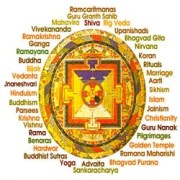
Non-indigenous religious system Indra, the god of war and weather is most frequently mentioned in the Rig Veda. Agni, the god of fire, is the second most prominently mentioned deity. The change in the form of worship is noticed from Yajur-Vedas which contains specific sacrificial formulas recited during ceremonies. In the Atharva-Veda, the variation is further marked as it consists of a number of hymns meant for magical incantations.
The Atharva-Veda, compiled perhaps as late as 500 BC, frequently refers to many lesser functional gods. During this time the rituals were simple and did not need the mediation of priests.
It was during the later Vedic period, that the Varna system was developed as a dynamic form of social institution that had religious underpinning. The Vedas speaks of four Varnas: Brahmans, Ksatriyas, Vaisyas, and Sudras.
In later Vedic age the Varna system was fully incorporated in the society and came to be known as caste system.
Subsequently, various subgroups within one caste led to the emergence of the Jati system. This in turn gave way to the rigid forms of pollution and purity. People since then were identified with their caste and Jatis in India.
The character and composition of Hinduism underwent metamorphic changes during the later Vedic period. The Hindu society became riddled with inequalities and its oppressive customs divided the society further. The whole worship system of Hinduism began to grow complex and complicated.
Many rituals developed around religion, which were beyond the reach of common man. It’s during this time Brahmin rishis and sages enjoyed unprecedented status.
Such confining system paved way for revolt against Hinduism and gave rise to two distinct religions i.e. Jainism and Buddhism.
Jainism - Ancient Indian Religion
Jainism was founded by Parsva in 800 B.C.E and spread by Mahavira around 550 B.C.E. It rigidly defined some aspects of Hinduism and shed some its characteristics.
Jains believed that karma has a physical existence in the form of material gathered on one's soul with every action one takes. It emphasized strict adherence to the principle of ahimsa (non-violence) to the exclusion of everything else.
The Varna system was maintained by the Jains with the exception of Brahman caste. Jainism was widely accepted among merchant and warrior class and was primarily a religion of the Ksatriyas and Vaisyas.
Buddhism - Ancient Indian Religion
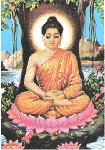 Siddhartha Gautama or Gautam Buddha, a royal prince founded a new religion called Buddhism based on four noble truths and a new social system.
 According to Buddha there is existence of suffering and its origin is desire, the cessation of suffering could be attained through the elimination of desire. The path to the cessation of suffering is through the eightfold way of right behaviour and thought.
Buddha declared Vedic sacrifice to be wasteful and cruel to other life forms and advocated people to sacrifice their hatred and avarice-to shed them. Buddha completely disregarded with the Varna system.
As a part of social system, Buddha developed Sangha, or Buddhist monastery. The Sangha was governed by the law of dharma with a spirit of equality, and unanimity in decision-making. The existence of the Sangha was not for a better material situation but for the desire of nirvana.
It’s till the Gupta period, Buddhism and Hinduism flourished side by side. After the decline of Guptas, the tenets of Brahmanic Hinduism and of the Dharmashastras underwent a radical transformation. The worship of Buddha started to be replaced by Hindu gods by the time its 8th-century.
This was the same period when Buddha was made an avatar of Vishnu in the Hindu pantheon of gods. This led to the rise of a mainstream "Hinduism" that overshadowed all other earlier traditions. This form of belief system continued till the eleventh century, when Muslims made inroads into India.
Contribute More Facts